
Dartmoor ponies: what families should know before a walk
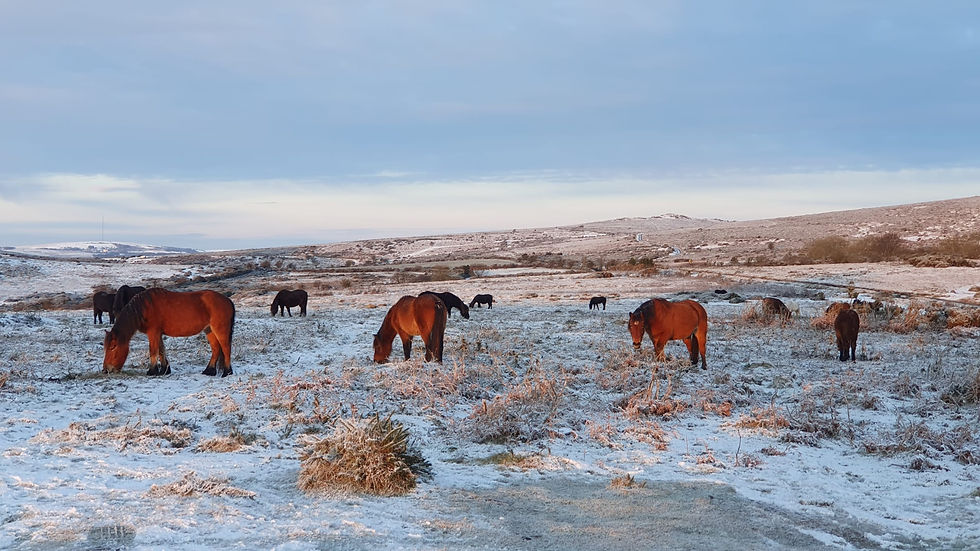
Spotting ponies on Dartmoor is a brilliant moment on a family walk. They might be grazing beside the path, standing in a small group on open moorland or, rather inconveniently, taking their time in the middle of the road. But they aren't petting-zoo animals, and the best way to enjoy them is to give them space.
Here's what we want families to know before heading out: why the ponies are here, what children should do when they spot one, and why even a well-meant carrot can cause real harm.
Are Dartmoor ponies wild?
Dartmoor's ponies roam freely across much of the open moor, but they are not ownerless wild animals. They belong to local farmers and commoners. Many are not used to being handled, and their behaviour can be unpredictable. The National Park Authority advises visitors not to approach or touch them.
That can be a useful distinction to explain to children. A pony may look relaxed, but a grazing animal isn't inviting us to stroke it. We can watch, take photographs from a distance and carry on without interrupting what it is doing.
Can you feed Dartmoor ponies?
No. Feeding ponies on Dartmoor is prohibited under National Park byelaws. That includes apples, carrots, sandwiches and the tempting last bite of someone's snack. Foods that seem harmless to us can upset a pony's digestive system or cause choking.
There is another problem too. Ponies that learn to expect food from people can start hanging around cars and roadsides. That's dangerous for the animals and for drivers. The simplest rule for the whole family is: look, don't feed, and don't touch. The National Park's pony guidance explains the reasons clearly.
What should children do when they meet a pony?
We find it helps to give children a clear job before they spot one: stop, stay beside the adults and watch quietly. Don't run towards a pony, try to stroke its nose, walk between a mare and foal or squeeze through a group of grazing animals. Choose a different line around them with plenty of room, or wait if the route is temporarily blocked.
Ponies can bite or kick if frightened or approached. If one comes towards you, stay calm, don't offer food, and move away gently when it is safe. A photo from a sensible distance is a much better souvenir than a close-up selfie.
If you're walking with a dog, keep it on a lead near ponies and other livestock. For the wider picture on exploring safely with little ones, our article Is Dartmoor safe to walk with kids? covers the practical basics.
What if ponies are standing in the road?
Slow right down and be prepared to stop. Livestock can wander onto Dartmoor's unfenced roads and narrow lanes, sometimes just beyond a bend. The posted speed limit is a maximum, not a target, especially when visibility is poor.
Never pull over onto a verge to feed or photograph ponies. Use proper parking areas instead. The Dartmoor Ranger Code has straightforward guidance for sharing roads and bridleways with livestock, walkers and cyclists.
Why are ponies important to Dartmoor?
They're part of the moor's working landscape and heritage. Grazing helps manage vegetation and contributes to the mix of habitats across Dartmoor. The ponies also have owners who care for and manage them, so they aren't simply left to fend for themselves.
If children are curious, turn the encounter into a little observation game. Can they see the ponies grazing, resting or moving together? What colours are their coats? Can they spot hoofprints without stepping close to the animals? Our Wildlife Wonders on Dartmoor article offers more ideas for watching nature without disturbing it.
What if you see an injured or distressed pony?
Don't approach or try to treat the animal yourself. Make a note of where it is, including a nearby landmark or location reference, and contact the Dartmoor Livestock Protection Officer on 07873 587561. If your vehicle is involved in a collision with a pony, you must contact the police. Keep children at a safe distance while you seek help.
A simple way to enjoy the encounter
Seeing ponies is a lovely bonus, but it shouldn't be the reason to change a safe walking plan or head off across unfamiliar ground. Choose a walk that suits your family's ability, check the weather, take your rubbish home and leave the animals to graze in peace.
That's the approach behind our Dartmoor Partner walking platform too: practical routes and helpful planning information, so you can spend less time wondering where to go and more time enjoying what's around you. For more ways to look after the moor as you explore, read Respect Dartmoor.


Comments